Most fintechs are highly efficient: they operate online, with no costly physical infrastructure. They launch, unencumbered by the legacy costs shouldered by their old-economy competitors, whose business they aim to steal.
Starting from scratch also offers technological advantages: their infrastructure is more up to date and the user experience is typically much better.
But, by and large, it is the very low cost base that gives them a competitive advantage: disruption comes from stripping out the fees that the previous generations of businesses levied to pay for their physical infrastructure.
There is, however, a subset of fintechs that now face having to get their hands dirty with bricks and mortar.
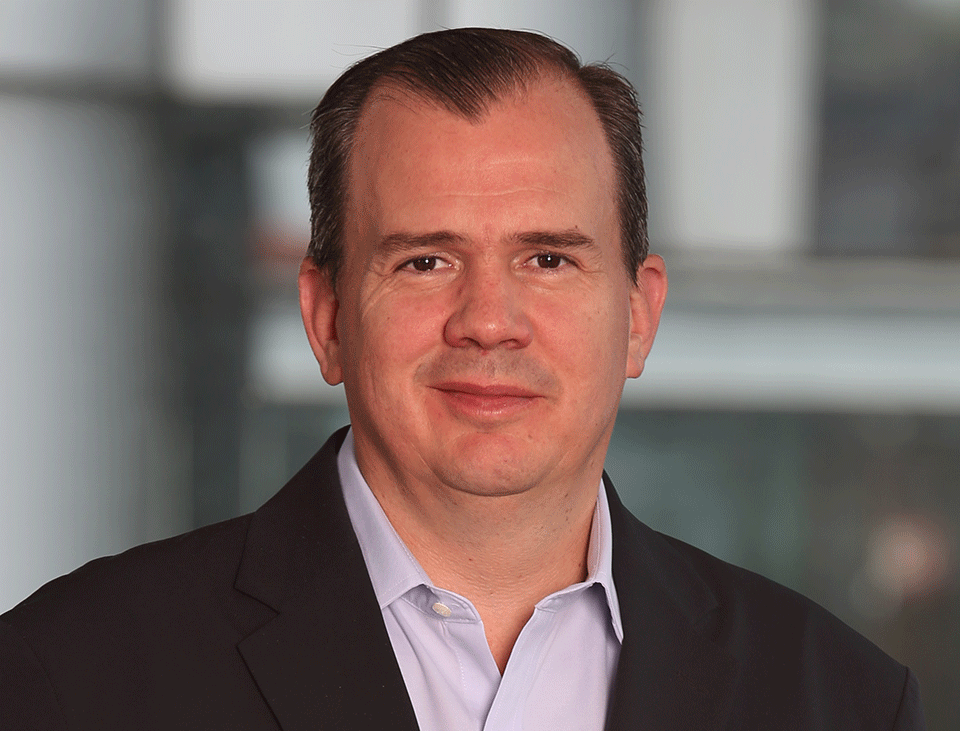
Creditas, the Brazil-based, SoftBank-backed secured-lending unicorn valued at $1.75 billion in its latest funding round, is one.
Its chief executive, Sergio Furio, explains that the company, which focuses on lending secured on car and real estate assets, is moving into the real world to manage the user experience, increase control of transactions that include physical interactions and improve the costs and performance of services that were being conducted by third parties.
For instance, it is opening a 30,000-square metre car reconditioning factory 10 kilometres outside the city of São Paulo that will be capable of handling 15,000 cars a month.
“There is going to be a tendency among fintechs to become more inserted in the use case to gain competitive advantage and to make a differential in the value proposition of the customer,” says Furio, speaking to Euromoney before the official announcement of the new car facility.
“If you want to gain competitive advantage in the car transaction space, you need to control the car transactions. To do that, you need to do the financing. By securing the customer, you extend the lifetime value [from that customer], and to do that you also need to become the dealer in the transaction.”
Complexity
Doesn’t adding physical operations add a lot of complexity?
“Yes,” replies Furio. “But we embrace complexity – we think it is wonderful. Simplicity is bad for the long-term sustainability of a business. That’s our approach.
“Obviously we had to hire an entire team – including a director of operations to manage the factory and the flow of cars – and there is quite a bit of tech needed to manage that as well.”
Furio points out that the company was already paying for much of this car-processing operation already – just through third-party suppliers.
“Every time we had a customer default on the car loan, we needed to repossess the car, which was usually delivered to a parking lot. That was outsourced, as was the company that did the [re-sale] auction.
“They would treat the car poorly – it would get scratched and bumped and would sit in the direct sun for more than 60 days – so that was depreciating the value of our asset. There was typical value destruction of 15% to 20% of the car value.”
Simplicity is bad for the long-term sustainability of a business. That’s our approach
Sergio Furio, Creditas
So Furio decided there was profit to be made by internalising this process. He is aiming to make Creditas “the best [used] car sales platform in the country”.
Part of this has an element of traditional salesmanship: putting in the ‘new car smell’, for example, but Furio predicts that increasingly fintechs that deal with physical products will operate between the digital and the physical worlds.
“We don’t think the distinction is being physical or being digital,” he says. “We have always been playing the online to offline because in home equity you need to go to the client and see the property and do the paperwork – there’s always logistics to that.
“The thing with the car business is that its about velocity and user experience, and how you can deliver a good return on the physical presence that you have. That is the most important component.”
Furio says that for Creditas this physical component will start with the car facility near São Paulo but expects that similar factories will be required in other regions. He also says that the bank “will probably come up with retail stores as well – inspection points for the digitally sourced customers”.
If clients wanted to sell their cars to Creditas, they would take them to the nearest physical location, where they would also be able to browse a list of remodelled cars in the company’s system, as well as financing (naturally) for cars. Other financial products would also be marketed to them.
“If I want to do auto loans, and I want to make a living from that, I need to continually re-invent how I plug myself into the value chain – even if it involves going deeper into that relationship with the customer and creating some physical locations,” says Furio.
He adds that the company’s operational strategy will evolve – the consistent element is how the bank sees niches: “The model that we are creating is [as a] platform related to your assets; we are not going to look like a regular bank.”
Limits
Not that these niches mean business opportunities are constrained.
Take the car finance segment alone: in Brazil the largest player today is Santander Brasil, which has a portfolio of close to R$50 billion ($8.8 billion). Creditas’s is R$1.25 billion.
“We can repeat our recent growth rates for the next five years and still only be at R$10 billion, still only be a fraction of the total market,” says Furio.
And while Creditas won’t compete with the traditional banks on traditional products, there is room for innovation.
The model that we are creating is [as a] platform related to your assets; we are not going to look like a regular bank
Sergio Furio, Creditas
For example, Creditas has no inclination to get into the traditional credit cards business, but it is planning to tweak its asset-based model to offer cards with limits that are fully secured.
“We could offer a credit card that is linked to your equity in your car, and the limit of that card would increase as the car loan is paid off – and we wouldn’t have losses on that because the credit card debt is collateralized,” he explains. Similarly Creditas is considering bank accounts that are linked to its home equity products – with rate incentives for those loans if clients pay their salaries into a Creditas account, which would help the company’s funding model by providing cheap deposits.
However, on the flipside, the traditional banks are also beginning to make meaningful progress in using new digital architecture to generate sustainable cost savings.
Segmentation
Of course, the easiest way to be efficient in terms of physical infrastructure is to start with very little – and it is not just the startups that enjoy this approach.
BTG Pactual – a long-time leader in investment banking and asset management for Brazil’s wealthy – is betting on building up its retail banking services with a purely digital approach.
Marcelo Flora, head of BTG Pactual Digital, points out that even digital-based platforms need to have scale to maximise profitability.
“It would have been difficult to have approved such a huge investment [in transforming the bank’s digital platform] if we maintained our offering just to the private banking segment,” he says.
Flora adds that BTG saw the opportunity of expanding its target audience at the same time as improving its technology.
He says that the BTG Pactual Digital brand is targeting the high income retail segment, which today has a total of around eight million accounts worth around R$1 trillion.
Banks don’t charge for these accounts, so Flora estimates that these eight million are held by between three and four million people.
There is also a mass retail segment in Brazil – where individuals tend not to have more than one account because they are charged – which also represents around R$1 trillion in total wealth split between 100 million people.
Flora says there is also some opportunity for BTG Pactual at the higher levels of this mass retail segment.
He says that the migration of this wealth has just begun, with around 80% still managed by the incumbent banks.
I believe we are gong to accelerate this wealth migration from the five big retail players – this is the real opportunity
Marcelo Flora, BTG Pactual Digital
“I believe we are gong to accelerate this wealth migration from the five big retail players – this is the real opportunity,” he says. “I believe BTG will be one of the two or three winners. The losers will be the big retail banks, as well as the global banks that still operate in Brazil but haven’t invested in their local technology in the same way that we did – they are probably more focused on other markets that are bigger and more important to them.”
Data from Morningstar shows that R$107.4 billion of fixed income assets under management left the leading two private banks – Itaú and Bradesco – in the 12 months to February 2021.
The five largest banks have a combined market share of 63.7%, down from 66.3% the previous year.
As well as the migration in the management of these fixed income assets, there is also a shift into equities and other risk assets that is leading to the quick growth in AuM of independent brokers.
Flora argues that while the leading retail banks will be the big losers of this wealth transition, only a few large platforms will be able to take advantage. He believes individuals will only migrate to investment platforms that are part of more holistic financial services companies – those that can also offer credit and accounts.
“These brokers are already seeing that they need to become banks in order to provide better services and products,” says Flora. “We are already a bank – we have been a bank for the last 30 years – and these brokers are finding it a very steep learning curve when they start to deal with a credit book.”
Brazil’s digital drive
In Latin America, traditional Brazilian financial institutions have taken the lead in revolutionizing their operating models to achieve structurally lower costs. That, in turn, can help these banks regain the advantages of their scale elsewhere, namely in funding costs.
Research by Goldman Sachs, led by financial institutions analyst Tito Labarta, suggests that the advent of digital banking – of which Brazil is a leader in Latin America – is allowing legacy brick-and-mortar banks to reduce the number of branches by an average of 3% a year.
There are outliers: for example, Bradesco cut its branch network by 15% in 2019 and 2020, while Banco do Brasil announced it would close 112 branches (though this kicked-off a political storm that ultimately led to the exit of the bank’s CEO Andre Brandao). This has also led to a corresponding reduction in headcount.
Labarta says that even with the recent reduction in Brazilian banks’ physical infrastructure, the country is ripe for additional closures.
“Brazil shows the most potential room for reduction in Latin America, with 14.8 branches for every 100,000 people – well above the average of 10.4.”
According to Labarta, digitalization has been the main driver of greater efficiency: “All of the banks in our coverage have been able to reduce operating expenses as a percentage of assets over the last five years. Itaú seems to have been the most successful so far, with a reduction of more than 100 basis points from 3.2% in 2015 to 2.1% in the first nine months of 2020 and a 60bps reduction compared to 2019 alone.”
However, he notes that there is still work to be done; Brazil’s banks must continue this savings drive to take their cost base to around 1.8% of assets by 2025 (from an average of 2.5% today) to make up for pressures on fees that fintechs are causing.
Labarta’s research shows that the ratio of fee income to assets has been shrinking in Brazil, and the trend is unstoppable.
In 2020, the average fee income of a Brazilian bank was 2%; Goldman Sachs expects this to fall to 1.5% by 2025 as traditional banks’ lose the ability to levy fees for services that fintechs and challenger banks offer for low or no fees.
Future model
Flora believes that while two or three digital platforms will dominate Brazil in the near future, there will be plenty of activity among the growing number of independent financial advisers (known as agentes autonomos).
He expects the development of the Brazilian market will follow a US-style model. He points out that there are more than 500,000 IFAs in the US; if the US economy is roughly 10 times the size of the Brazilian economy, then he expects Brazil to need 50,000 IFAs. Today, there are between 2,000 and 3,000.
However, there are many bankers inside big retail banks that are qualified as IFAs, and as the banks shed headcount many will be forced – or will jump – into the IFA model.
“The activity underneath the couple of winning platforms is going to be wild,” he declares.
Rocket fuel
Furio suggests the incumbent banks have one last card to play in terms of surviving the digital onslaught: credit.
He believes that the Covid-19 pandemic has put rocket fuel into the banks’ ability to cut costs by cutting back on brick-and-mortar branches.
According to a report by Standard & Poor’s, the pandemic has led to a big increase in the number of digital customers at Brazil’s banks. Combined, Itaú, Bradesco and Banco do Brasil added 8.8 million new users to their online roll book in the last 12 months.
Itaú saw an 11.2% year-on-year rise, to 14.9 million clients as of the third quarter. Bradesco and Banco do Brasil reported 13.9% and 33% growth respectively, to 20.5 million and 19.5 million clients.
Furio believes the Brazilian banks could cut their branch networks by as much as half. That is a big reduction in headcount.
Such cost savings could turn the tables on the fintechs by giving the large banks a cheaper cost of funding, in turn enabling them to offer better interest rates on loans. That might push some of the new credit-based fintechs out of the market. However, there will, of course, be a need for an increase in technology expenditure. Itaú, for example, announced in its 2020 results presentation that it has hired 3,700 tech professionals in the last year, adding 260 data scientists in the fourth quarter alone.
Furio says that such a radical reshaping of the big banks’ models – and the subsequent efficiency gains – could bring the personal loan rates offered by these banks down to around 55% by 2025, from an average of around 85% in 2020. However, as he notes, this wouldn’t greatly impact the appetite for demand for lower rate loans based on secured and payroll lending products that allow innovative companies in this sector – such as Creditas – profitable niches in which to thrive.
‘We aren’t bothered about profitability in the short-term’
In December, Creditas raised $255 million in a funding round that valued the fintech at $1.75 billion. The money will allow it to continue the expansion of its credit portfolio and extend products and services.
Chief executive Sergio Furio says the bank trimmed its losses in the last year, mostly from taking a conservative stance during the first half of 2020 as the Covid-19 pandemic hit Brazil.
“2020 was a very challenging year,” he explains. “We had growth of 300% in the first quarter when compared with the first quarter of 2019, but in the second and third quarters, we took out the growth and started growing by only a couple of percentage points per month – compared to the 8pp or 9pp in Q1. Then in Q4, we put the growth back in.”
He points out that the company’s model is extremely scalable: unlike a bank that needs to retain regulatory capital, Creditas recycles its loan portfolio through securitizations in the local market.
Furio says the aim in the middle quarters of 2020 was to reduce cash burn and manage credit risk, so the company slashed its marketing budget by 90% between April and June. It began to increase marketing again in July, returning to normal levels by September.
“All the months in the last quarter were record months, and we ended the year in a very positive mode,” he says. “Looking back it was a mistake to slow down the growth – we managed to securitize our portfolio every single month of the year. We were one of the few issuers doing that, and that speaks a lot about the perception of quality that investors have to our company.”
Furio claims that as the pandemic hit – creating uncertainty about the credit quality of underlying securitizations in the market – the fact that Creditas’s were fully secured drove demand for its transactions.
The company, which has recently begun operations in Mexico, is using the capital from its latest equity raise to support the operating losses it incurs from its technology investment and marketing spend.
Creditas has 500 developers – a considerable investment that isn’t capitalised, but goes straight into expenses.
The other cash burn is marketing, specifically the customer acquisition cost (CAC).
“In lending a product, you spend money in marketing and operations; that money comes back over a relatively long time frame – up to 20 years with home equity loans,” says Furio. “So, if I want to grow fast, I need to spend money on CAC, but it is good money.
“The important thing isn’t the accounting losses – it is the value of those losses in the future, or my projection of the money I’m going to get back from the CAC investment.”
In 2020, Creditas cut its losses, but, Furio says, “I wouldn’t interpret that as a trend”.
He expects that the company’s losses will increase this year because it aims to grow the business at a faster pace – including launching new business.
“We aren’t bothered about profitability in the short term,” he says.
However, he concedes that the road to profitability would have to be part of the story for an IPO. “If we continue to grow fast, then potentially the company could breakeven in a couple of years while still growing fast,” he says. “The important thing from our perspective is the unit economics: for every penny spent on CAC and technology, how much does that return in cash?
“That’s where we are focusing. We are not currently working on an IPO, but it is a possibility in the next couple of years – maybe three.”