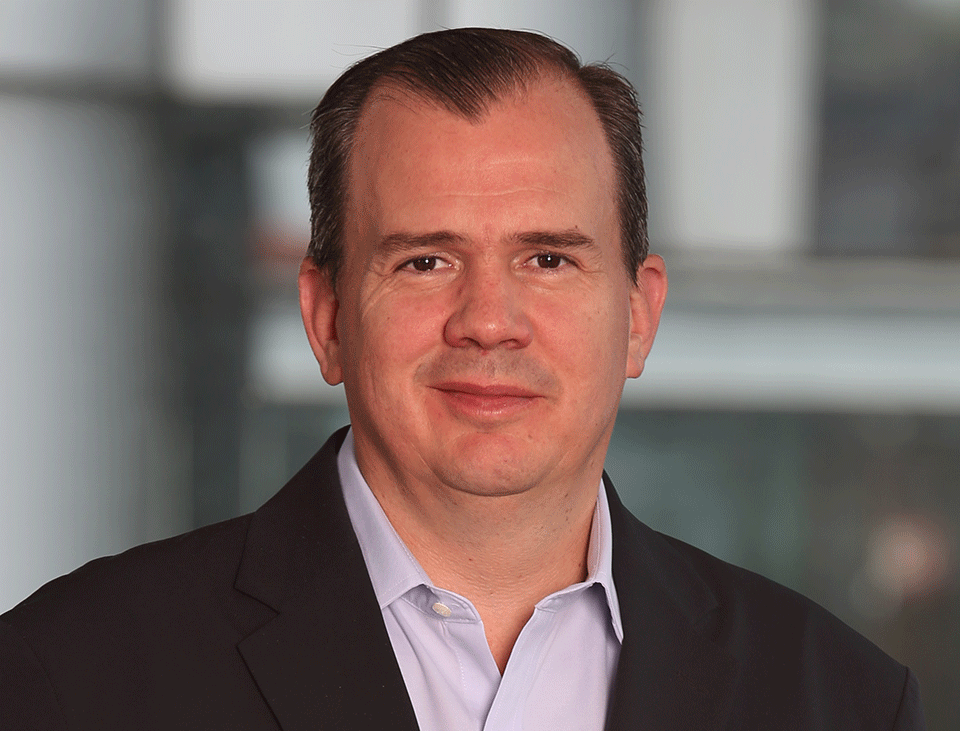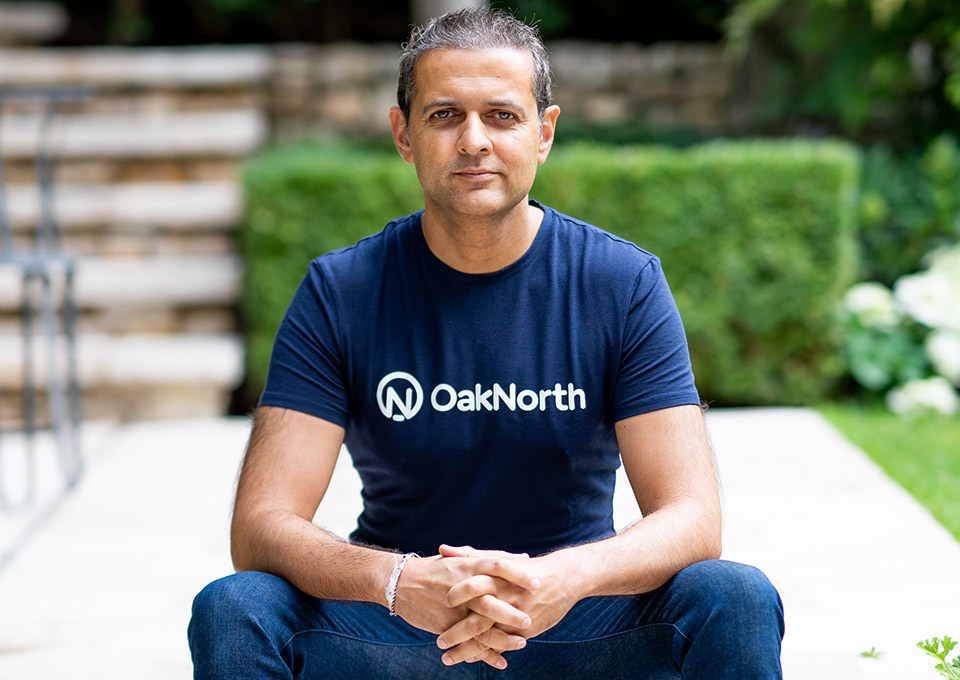
Rishi Khosla, co-founder and chief executive of OakNorth, is clearly someone who fights hard to get things the way he wants them. If he is interrupted mid-flow, he will politely but firmly insist to Euromoney on finishing precisely what he wants to say.
He enjoys an energetic lifestyle: weekend days at his rural bolthole apparently begin at the crack of dawn, with him leading his family on a jog across the countryside.
For staff at OakNorth, too, this is no time to rest. Up to now, the bank has outshone the other UK neobanks that were founded in the mid 2010s.
Jump to:
It is the only one known for building up the asset side of the business – in its case, offering loans to small and medium-sized enterprises of between about £1 million and £40 million. This was a more obvious strategy when rates were low but now, with higher rates, gathering low-cost retail deposits is much more profitable than it was before, while borrowers’ repayment capacity in areas such as unsecured consumer credit and SMEs is weakening.
It is no surprise, therefore, that the credibility gap between the business models of OakNorth and rivals such as Monzo and Starling Bank, some of which previously struggled to make money from retail accounts, has narrowed.
“Banks purely focused on gathering deposits had no business model two years ago,” Khosla acknowledges. “Now they have a business model.”
Khosla founded OakNorth together with partner Joel Perlman in 2015, around the same time as Monzo and Starling were launched. Khosla and Perlman were previously successful in founding financial research outsourcing company Copal Partners, sold to Moody’s in 2014.
Euromoney wants to ask Khosla what a rate-fuelled bear market in UK real estate will mean for OakNorth, given its overwhelming focus on lending to small and medium-sized real-estate developers – a sector that most bankers would consider at the extreme end of the risk spectrum, even at the best of times. Most people working at new lenders such as OakNorth have only experienced exceptionally low rates.
“The cost of money has changed dramatically from anything it has been in the past decade,” Khosla observes. “Who remembers higher rates and higher inflation? Who has lived through that period?”

Even before former prime minister Liz Truss’s disastrous mini-budget in September 2022, confidence in UK real estate was falling because of a sharp rise in interest rates. The market then spent the rest of the year in a state of anxious suspension.
The lack of price discovery has allowed some owners to cling onto the hope that property assets will hold up relatively well. Nonetheless, there is a growing acceptance that real-estate values are on the way down, perhaps even in sub-sectors that were previously seen as solid, such as logistics and student housing.
Prime capital values in the UK, France and Germany had already fallen by 7% in 2022, according to AEW Research & Strategy. Previously, the forecast was for a much bigger post-Covid bounce, but by 2023, capital values in the UK are now expected to be 12% below 2018 levels.
Clearly without price declines, real-estate yields won’t be sufficiently attractive based on higher financing costs. The squeeze on affordability from both rates and inflation is dampening the previously buoyant owner-occupier sector, too.
Some real-estate lenders have already pulled back. And all banks – including OakNorth – appear extremely reluctant to refinance at higher leverage than they would have done before.
Real estate owners will therefore need to put in more equity to make up for any decline in value or sell up – although of course that will add to the downward pressure on prices.
“The simple fact that the property is worth less now – and therefore on renewals, something has to give – is a reality of where we are,” Khosla says.
He emphasises that, from his perspective, there is less of a funding gap in areas such as student housing and residential real estate more broadly.
“It pinches the most today on commercial real estate, where you’ve had cap rates widen, especially for grade-B and grade-C offices, and you’ve had rentals fall,” he says.
The loan-on-loan market, which previously propelled real-estate price rises by offering debt funds leverage from banks, effectively closed in the middle of last year. OakNorth was one of the best-known players in that market at the smaller end of transactions.
Yet loan-on-loan funding was never a big part of what the bank did. Along with capital call lines for private equity firms, loan-on-loan funding only accounted for a single digit percentage of OakNorth’s loan book.
So, OakNorth has, for the most part, continued lending. That is primarily thanks to its credit-intelligence software, international sales of which also make up a useful adjunct to its credit income. US banks Capital One, Fifth Third and PNC are among its software-as-a-service clients.
“We’re well over capitalized and we make money,” Khosla says, when asked if OakNorth will be tapping further funding soon. SoftBank led its last funding round in 2019, which raised $440 million for a $2.8 billion valuation.
He adds that deposits are between 120% and 130% of its loan book, making rising wholesale funding costs less of an issue for the bank.
Speaking to Euromoney in early February, Khosla still expects an average annual cost of risk of 11 basis points. That is more than the 0% credit losses OakNorth boasted of in its early years.
The bank saw a spate of developer defaults in the first year of the pandemic, but 11bp is still extremely low – about a third of the UK banking average, and perhaps a 10th of the cost of risk banks would normally expect from SME real-estate developers.
“If you’re in the lending business, or any business when you take risk, ultimately there will be a cost to that risk,” Khosla says. “Do I expect overall losses in the lending space to go up? Yes, absolutely. Do I expect OakNorth to do better than the market? I would say: yes. But that doesn’t mean we won’t have losses – of course we’ll have losses.”
Business mix
Perhaps because of its SME focus, OakNorth is hearteningly proactive when it comes to seeking clients’ permission to talk publicly about its borrowers.
One long-standing client is Notes, a small chain of London coffee shops. The firm’s in-house barista hands Euromoney a cappuccino in a Notes cup at OakNorth’s headquarters, just off London’s Carnaby Street – between Soho and hedge fund-filled Mayfair.
Beyond lending to local coffee shops, 60% of OakNorth’s loan book is in the real-estate sector. Much of the rest of its lending is for SME management buy outs (taking security over cash flow) and lending to hotels, something Khosla insists is a business, rather than real-estate, risk.
Even among SMEs, real estate and M&A is where Khosla sees most need for capital. “There’s been less demand for pure growth capital in more traditional businesses in the UK and more demand driven by corporate activity of some sort,” he says.
In early 2023, OakNorth’s deals include funding an investment by private equity firm TriSpan in Mowgli Street Food, chef Nisha Katona’s restaurant chain; a loan to a 360-bedroom student accommodation development in Lincoln, in the English Midlands; and a loan to Wirefox Real Estate Group for its acquisition of Ardgowan Hotel in St Andrews, Scotland.

David McCreadie, chief executive of Secure Trust Bank, notes lending to real estate has long been useful for banks – including for older challengers such as Secure Trust – because the average ticket size is large compared with other SME loans and because the capital charges are much lower than in unsecured lending.
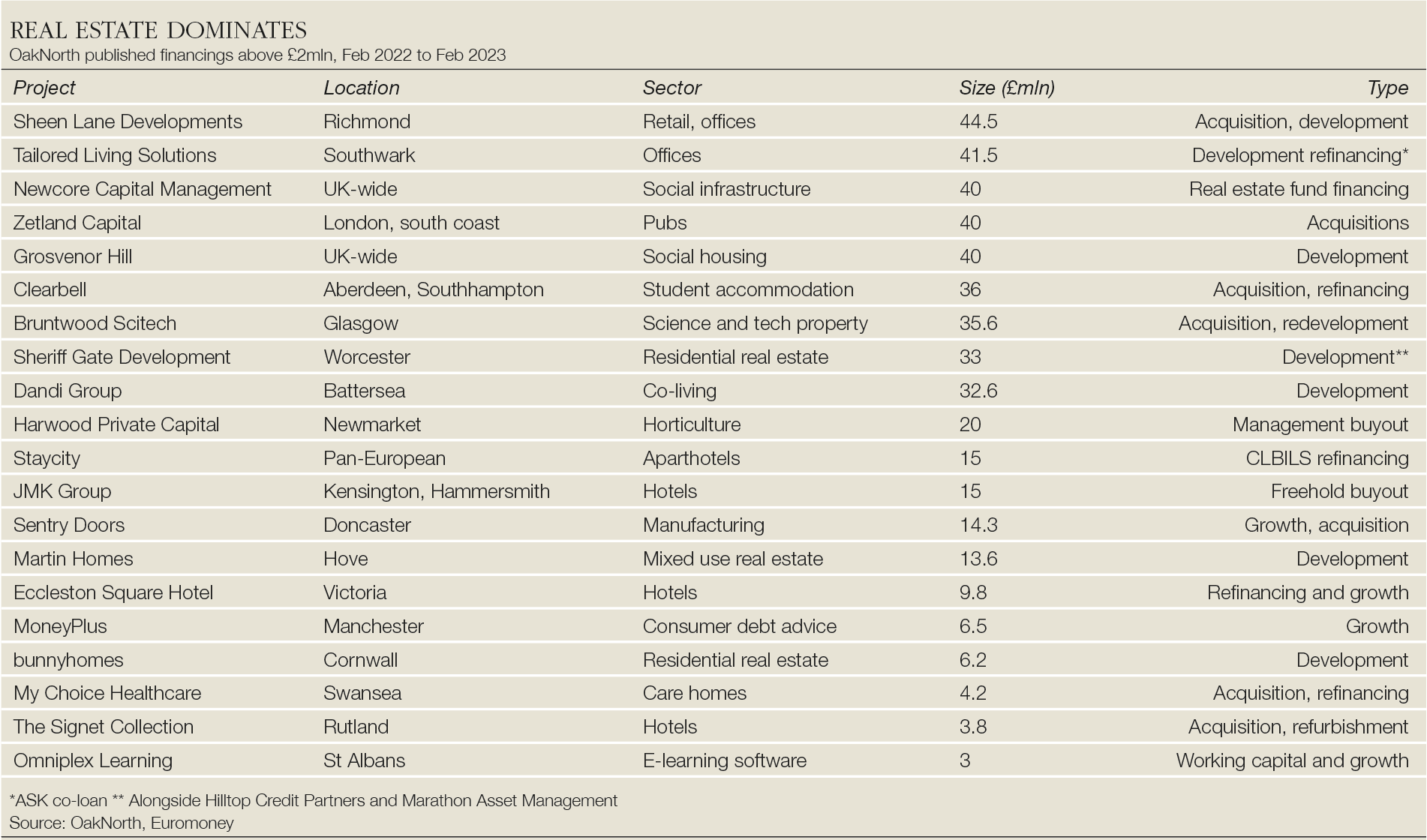
At OakNorth, too, over the past year, real estate dominates the list of disclosed deals by number and especially size. Eight of its 10 disclosed deals above £20 million were for real-estate development.
Nevertheless, OakNorth’s appetite for higher leveraged real-estate borrowers appears to be below other challenger bank lenders to real-estate development, such as Secure Trust. OakNorth’s average loan-to-value (LTV), just above 50% according to Khosla, is also well below the typical levels of leverage that real-estate debt funds offer.
Even a stress scenario of a fall in UK house prices of between 20% and 30% should therefore do little to the bank’s cost of risk.
The bank’s purchase of a 50% stake in fintech lender Ask in October partly speaks to the bank’s preparedness to lend at higher levels of leverage.
Ask and OakNorth had previously partnered on deals to allow OakNorth’s clients to borrow at a higher debt-to-equity ratio – even though the bank maintained relatively low risk, as Ask funded a mezzanine tranche.
Ask works by grouping high net-worth individuals, family offices and institutional investors on its platform to subscribe to individual real-estate deals.
Ask was already working with OakNorth before the acquisition. Last August, the two co-lent £44.5 million to Sheen Lane Developments to redevelop a former House of Fraser department store in Richmond, an affluent London suburb, into office and retail space.

Most recently, in February, they co-lent £41.5 million to Tailored Living Solutions, refinancing a development loan for offices in Southwark, in central London.
“For us to be able to offer mezz and senior together as a package, as we have for many clients, makes sense,” says Khosla. “They focus on providing mezz. We focus on providing senior. Many clients want mezz and senior.”
OakNorth’s eagerness to lend higher up the capital stack is also why the bank has gravitated to the loan-on-loan market, where it would typically offer a 50% or 60% LTV ratio for debt funds – again often funded by family offices – that might in turn only be lending at a 60% LTV ratio.
“We add quite a bit of value in loan-on-loans, as when one of the funds is looking to make a loan, we will run the analysis through OakNorth Credit Intelligence and give them our perspective on the metrics,” Khosla says. “We still care about them not losing money, even though our attachment point is so low.”
The other factor that may protect the bank from falling real-estate prices is that it has lent more to homebuilders – mostly affordable and social housing – than to developers of offices and retail space, where a cyclical downturn has combined with an accelerated structural change in demand.
“That was a very conscious decision very early on,” Khosla says, talking about the deals the bank has done throughout its eight-year life. “There’s a structural deficit of housing stock in the UK, which means the supply-demand situation for affordable housing in the UK is askew. So you’re helping the country and you’re playing into a macro-trend.”
Housing shortages mean that there is a stronger backstop in demand for houses selling at about £300,000 or £400,000 than those selling at £1.5 million or £2 million, Khosla explains. People will fight hard to get out of expensive and precarious private tenancies in poor-quality dwellings.
“At the £300,000 level, it is where people are starting off,” he says. “There’s a higher impetus to move. You’re driving more to basic requirements.”
Missing middle
Despite OakNorth’s focus on the UK, Khosla still insists that low losses will be maintained thanks to its use of an innovative data platform to assess SME risk.
That approach allows it to lend in a relatively bespoke manner to the underserved segment between retail and large corporate borrowers. Most banks struggle to lend to what Khosla calls this “missing middle”, because the loan tickets are too small to justify the cost of standard corporate credit analysis, but also too big for statistical models that accept a certain level of losses.
“The reason why OakNorth exists, and the reason why we service our customers in the way we do, is because we’ve combined the statistical approach with the analytical rigour of large corporate lending,” he says.
OakNorth claims to use a wider variety of metrics and data points than other lenders on each individual loan, allowing it to form a more precise view on the likely time and cost of construction; the eventual value of the units; and the time it will take to sell them – for that type of property in that specific area – rather than relying on third-party valuations and a rules-based approach to assessing how long such a development should take to complete.
The sick man of Europe
Compared with the rest of Europe, the economic outlook is particularly gloomy in the UK. The IMF warned in early 2023 that the country would be the only big economy to contract this year. It is a situation many blame in large part on an unnecessarily hard Brexit, which was a policy implemented by a political party to which OakNorth’s co-founder and chief executive Rishi Khosla has formerly been personally connected.
His status as an important donor to the Conservative Party – coupled with OakNorth’s employment of former Conservative Chancellor Philip Hammond, as an adviser – started to attract press attention around two years ago.
Khosla stopped donating to the Conservatives around the same time, well before Liz Truss’s brief and turbulent ascent to prime minister.
“I lost the desire to spend too much time in that world, given the state of that world,” he reveals, when asked about ending his political involvement.
Looking to the future, Khosla admits that the economic picture in the UK is not pretty.
“It is going to be a tough environment,” he says. “To think about it any other way is crazy.”
At the corporate level, Khosla draws some comfort from the legacy of the economic stimulus of the Covid era, including the UK’s government-guaranteed lending schemes.
“A lot of cash got pumped into the system,” he says. “Companies are sitting on higher cash balances even today than they would traditionally do.”
Nevertheless, he recalls how the cycle already felt late in 2019. So, while recent revenue growth may have made the debt of higher-levered borrowers look more manageable, things could change as their revenues fall, now that fiscal and monetary policy has tightened.
“Do I think it is not going to be so bad after all, and it’ll just be a very mild recession and we’re not really going to feel it? I would say that is pretty hopeful thinking.”
Khosla, who started his career as an investment banker at ABN Amro, says this more tailored and relatively data-rich approach to lending helps in more than just the initial credit decision. It also helps OakNorth support borrowers over the longer term: notably by alerting them to potential problems in their sector before those problems are well-known.
He points to events after the Covid reopening, when developers started to experience shortages of building materials.
“We identified supply-chain constraints well before the market; we went to our developers and said: ‘Guys, you wouldn’t be doing badly if you stockpile your materials’,” Khosla says. “A number of developers took that advice and they just hummed through it when there were extreme shortages of things like steel and timber.”
Khosla says that the platform can help in forming a view about how certain events might affect borrowers’ cash needs more rapidly, so that it can encourage the worst-impacted borrowers to put aside more cash or delay costly expansions before their loan is due for renewal.
“Our approach since we started the business has been to have forward-looking stress scenarios which we share with borrowers and we get them on side,” he explains.
This proved its worth after the UK mini budget last year that then-Chancellor Kwasi Kwarteng announced on Friday, September 23. By the following Monday, OakNorth had put together a new stress scenario about what it could mean for the country. By Tuesday, it had run that scenario through its loan book and decided which borrowers it needed to contact. By Wednesday, it was already speaking with those borrowers – all far quicker than a traditional bank, Khosla claims.
“With OakNorth Credit Intelligence, we have monthly data from our customers so at any point in time we know how our customers are doing, but we also know how they’re doing against our forward-looking scenarios,” he says. “We always know which are the two, five or 10 borrowers who have pinch points. We know how to find the needle in the haystack, and we are finding those issues before they become real issues.”
All this adds to his faith that the bank can get through the worst of 2023 without much larger losses. More than that, however, Khosla says it affords OakNorth’s bankers more time and surety to continue to lend, particularly at times of stress – like now.
“A standard bank will lend money through an up cycle,” he says. “The cycle starts turning. Things look a bit scary. You start asking what is going to happen with the back book and where are the losses going to be? You don’t really have visibility on how each underlying company is performing, so you put the brakes on. You analyse the back book and figure out what is happening. Then you slowly start lending once the market gets better.
“Our own confidence to continue lending through the cycle is much higher.”
How justified this confidence proves to be will become clearer as the UK economy tackles the severe tests ahead.